|
|
| |
 Skills
 |
| Imagine a
1,000-foot tall sheet of vertical, continuous, seamless glass. If
you had to climb it, it would be impossible unless you have suction
cups for your hands and feet. Now imagine a 1,000-foot tall vertical
rock wall filled with cracks and outcrops that are so obvious and
so easy to find that you can climb it like you climb a ladder. Rock
climbing always falls somewhere between these two extremes.
In the easy case there isn't really any skill involved at all.
As long as a person is in decent physical shape, it's possible for
just about anyone to climb a rock like this. As the rock gets smoother
and the handholds get farther apart and smaller, the climber begins
to enter the realm of nuance and finesse. The climber must be able
to find adequate handholds and footholds, balance on them in often
precarious positions, and move from one point to the next without
falling. On difficult routes there can be thin cracks with little
to grab hold of, overhangs that require incredible strength to traverse,
and wind and temperatures that make the route up the rock even more
challenging.
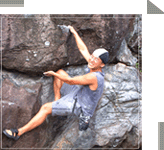
Whenever possible, the climber is trying to do most of the work
of climbing using his/her legs. In the ideal case, climbers try
to keep their centers of gravity over their feet and then push upwards
with their legs. They use their arms and hands only for balance
and positioning. As the rock becomes smoother, it becomes harder
to stay in this ideal position. This is where strength and agility
come in. On difficult routes, the climber needs incredible arm,
hand and finger strength and endurance to stick to the rock. On
extremely difficult routes, finding enough things to hold onto in
a continuous sequence becomes a complex geometry problem.
|
| |
| |
Rating System |
| |
In Malaysia,
we use the France Grading System. Climbers use a standard
rating system to describe the difficulty level of different routes.
There are 9 grades
in this system, ranging from Grade 1 (Normal Walking) through
hiking, scrambling and then climbing at grade 5a. "Rock
Climbing", falls under grade 5a and onwards.
5a
to 5c -
Beginner Level, easy to climb
like a ladder, climbable in normal shoes or boots but requiring
more skills.
6a
to 6c -
Intermediate Level, requires
climbing shoes, experience and strength, stamina and balancing
7a
to 7c -
Expert Level, harder routes,
balancing, finger power, more foot work required and
strongly motivated
mindset
8a
to 8c -
Master Level, perhaps only the
top 10% climbers in the world can handle these routes.
9a to 9c -
Elite Gurus Level, can
be handled only by "The Best of The BEST !.....
|
|
| |
| So far, we've
learned that there are several forms of rock climbing and that each
requires different levels of skill. Strength, stamina and control
are integral to mastering the sport. Some other important aspects
are the equipment and climbing technique. In the next section we'll
take a look at the equipment and techniques involved in sport climbing.
|
|
|
| |
|
Equipment & Climbing Technique |
CLIMB ROCK without
equipment? Yes it is possible, but safety COULD be compromised !
We need Climbing Equipment for safety ! |
| |
| |
• |
Rock Climbing shoes
|
| |
Climbing shoes enhance climbing
ability much like running shoes enhance running ability. |
| |
   |
|
• A harness and carabineers for attaching
the harness to the rope
|
| |
|
|
 |
|
 |
|
• A belay device and a rappelling device
|
| |
|
|
 |
|
 |
|
• Gloves or hand chalk
|
| |
|
|
| |
|
|
| • A dozen
quick draws / runners |
• |
A helmet |
| |
|
|
| On a typical
sport route, two climbers would use this equipment like this: |
| The first climber
to climb the route is known as the lead climber. While he/she is climbing,
the lead climber is protected by the rope attached to his/her harness.
The other end of the rope is held by the second climber, who is known
as the belayer. The belayer runs the rope through a belay device attached
to his/her harness and feeds rope out as the lead climber rises. |
| |
|
As the lead
climber climbs, he/she will come to the first bolt on the rock wall.
A bolt is a permanent anchor that has been drilled into the rock.
There's a metal loop attached to the bolt. The lead climber uses a
quickdraw to connect the rope to the bolt. A quickdraw is a pair of
carabiners attached together by strong nylon webbing. The lead climber
hooks the carabiner on one end of a quickdraw to the bolt, and runs
the rope through the second carabiner on the other end of the quickdraw.
The lead climber proceeds up the route, hooking into each bolt as
he/she comes to it. |
| |
|
| If the lead
climber falls, the belayer will grab the rope to arrest the fall.
The maximum distance that the lead climber can fall is equal to twice
the distance between the last bolt and his/her current position, plus
the length of slack left in the line by the belayer, plus the stretch
of the rope. Climbing rope stretches to absorb the shock of the fall.
So, if the lead climber is 4 feet (1.2 meters) above the last bolt
that he/she clipped into, the climber will fall 8 feet (4 feet to
get even with the bolt and then 4 feet past it), plus the length of
the slack in the line, plus the length that the rope stretches. Perhaps
10 to 12 feet (3.4 meters), in other words.
The lead climber can climb to a maximum height equal to about half
the length of the rope. If the lead climber goes any higher than
that, it will not be possible for the belayer to lower him/her back
to the ground if the lead climber falls and is injured. Since most
ropes are 50 to 60 meters long, it means that the distance that
the lead climber can climb before stopping is 25 to 30 meters (75
to 90 feet).
The lead climber will climb to a ledge, tie into an anchor in the
rock with a short piece of rope or webbing, and the two climbers
switch roles. The lead climber become the belayer from above for
the second climber. The second climber detaches and collects the
quickdraws placed by the lead climber as he/she climbs.
Once the lead climber and the second climber are together again,
they have completed the first pitch. They will then repeat the process
to climb the second pitch, and so on, until they reach their destination.
Traditional climbing follows the same steps. However, instead of
attaching to pre-placed bolts, the lead climber carries and places
temporary protection (aka pro) along the way. Protection is placed
into cracks in the rock and comes in several different forms:
|
• Wedges
• Nuts
• Hexes
• Cams
The lead climber places protection into cracks as he/she climbs, and
the second climber removes all of it as he/she follows. The placement
of protection is obviously a crucial skill, since protection devices
are the only thing that stand between life and death in a fall. The
protection must be placed so that it locks into the rock and holds
firm during the stress of a fall. |
|
|
| |
|
Getting Started |
| Probably the
easiest and safest way to get started in rock climbing today
is to go to an indoor climbing facility and take lessons. There
you will learn the basic techniques in a safe environment, build
your strength and skills, and meet other climbers. Any major
city will have two or three climbing gyms in the area. Once
you understand the basics, you can find a partner and head out
to start on easy sport routes. As you gain experience you can
move up to more advanced routes. |
|
| Many climbers never
move beyond sport climbing because they like the safety and
speed of using pre-placed bolts. If you want to try advanced
routes, or routes in remote areas, then you can learn how to
place protection and try out traditional climbing. In making
the jump to traditional climbing, it is essential to find a
partner or hire a guide/instructor with traditional climbing
experience so that you can learn how to safely place protection
yourself. |
|
|
|
| |
|